The History of Welsh Slate and Its Importance in Modern Roofing
Welsh slate is world-renowned for its durability, appearance and longevity. For centuries, it has been the preferred roofing material for homes, churches, public buildings and landmarks across the UK and beyond. Understanding the history behind Welsh slate helps explain why it remains one of the most trusted roofing materials today.
The 1830’s were very important for the slate mining industry in North Wales. Gwynedd’s slate dominated the world for building and roofing, with it going as far as America, Poland and Australia. The three main slate mines in the area were Penrhyn Quarry in the Ogwen Valley, Dinorwig in Llanberis, and the mines of Blaenau Ffestiniog.
This period marked the height of slate production in North Wales. The industry supported entire communities and shaped the landscape, economy and identity of Gwynedd. Even today, many original slate roofs installed during this era are still performing exceptionally well.
Penrhyn Quarry was one of the largest open quarries in the world. It even became a popular attraction for tourists, including Queen Victoria before her reign.
The sheer scale of Penrhyn Quarry was unmatched at the time. Its slate was known for its consistent quality and colour, making it ideal for roofing large buildings and prestigious projects across the world.
Many heritage properties across North Wales still rely on original Penrhyn slate, highlighting the importance of skilled slate repair and maintenance rather than unnecessary replacement.
Quarrying was a hard and dangerous process, and relied on sheer muscle power to remove the slate. At Penrhyn, the men worked on open galleries and terraces. They hung from ropes tied around their waists, using handheld wedges and crowbars to hack the slate off the mountain. Gunpowder was also used to create explosions which blasted the rock – the powder was packed tight into holes which were drilled into the rock face and pushed down with an iron rod. It’s not hard to believe accidents were often and a constant risk.
The quarrymen’s skill and resilience laid the foundations for the slate industry we rely on today. Each slate tile was carefully extracted and shaped by hand, a level of craftsmanship that continues to influence modern slate roofing techniques.
At Penrhyn, the slate seams were on the surface of the mountain, which allowed the workers to access it from the terraces. However, in other parts of Gwynedd, the slate seams went underground, so the quarry workers had to cut into the mountain to reach it.
This difference in geology meant that slate extraction methods varied widely across the region, contributing to the unique characteristics of slate from different areas.
This was the case at the mines in and around Blaenau Ffestiniog. Rows of huge chambers were left as the workers removed the slate from deep in the mountains. These chambers were only separated by slim walls or pillars made up of slate to support the roof.
The underground mines of Blaenau Ffestiniog were among the most challenging working environments in the slate industry. Despite this, the slate produced here became highly valued for its strength and resistance to harsh weather conditions.
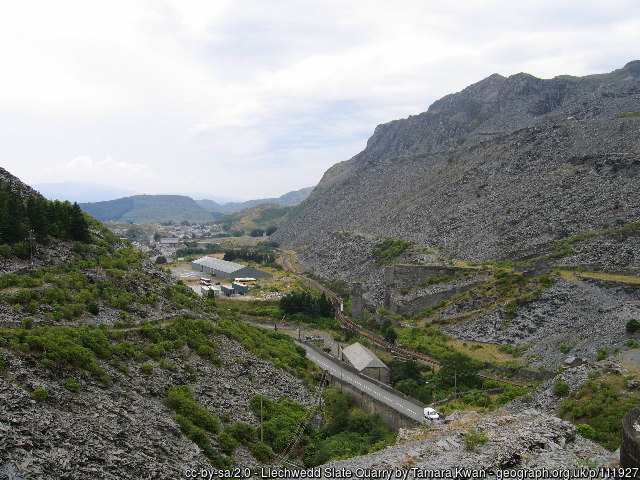
A huge problem they encountered was how to dispose of the waste material. For every ton of slate mined, there would be nine tons of waste. Huge tips ended up reshaping the landscape of Gwynedd, and are still there today.
These slate tips remain a visible reminder of the industry’s scale and its lasting impact on the Welsh landscape. They also serve as a powerful symbol of the industrial heritage of North Wales.
You can visit the remains of the slate mines here at Llechwedd Slate Caverns. There are tours into the mines which give you an insight into the hard working conditions they endured.
Visiting sites such as Llechwedd helps people better appreciate the effort and expertise behind every slate tile that has been used to protect homes for generations.
At the beginning of this year, the slate mining landscape of Gwynedd was nominated to become the UK’s next World Heritage Site, alongside others like the Grand Canyon and The Great Wall of China. This is an excellent way to recognise how important the history of the slate mines is.
This recognition highlights the global significance of Welsh slate and the craftsmanship behind it.
Welsh Slate Roofing Today
Today, Welsh slate remains one of the most durable and visually striking roofing materials available. When installed and maintained correctly, a slate roof can last well over a hundred years.
At MG Roofing, we specialise in Welsh slate roofing across North Wales. Our experience working with traditional slate allows us to repair, restore and install roofs in a way that respects the material’s heritage while meeting modern standards.
Whether maintaining a historic property or installing slate on a new build, choosing experienced local roofers who understand Welsh slate is the key to protecting your home for decades to come.